
Talking About Complexity
In Conversation with Ellie Snowden and Anna Panagiotou from The Cynefin Co
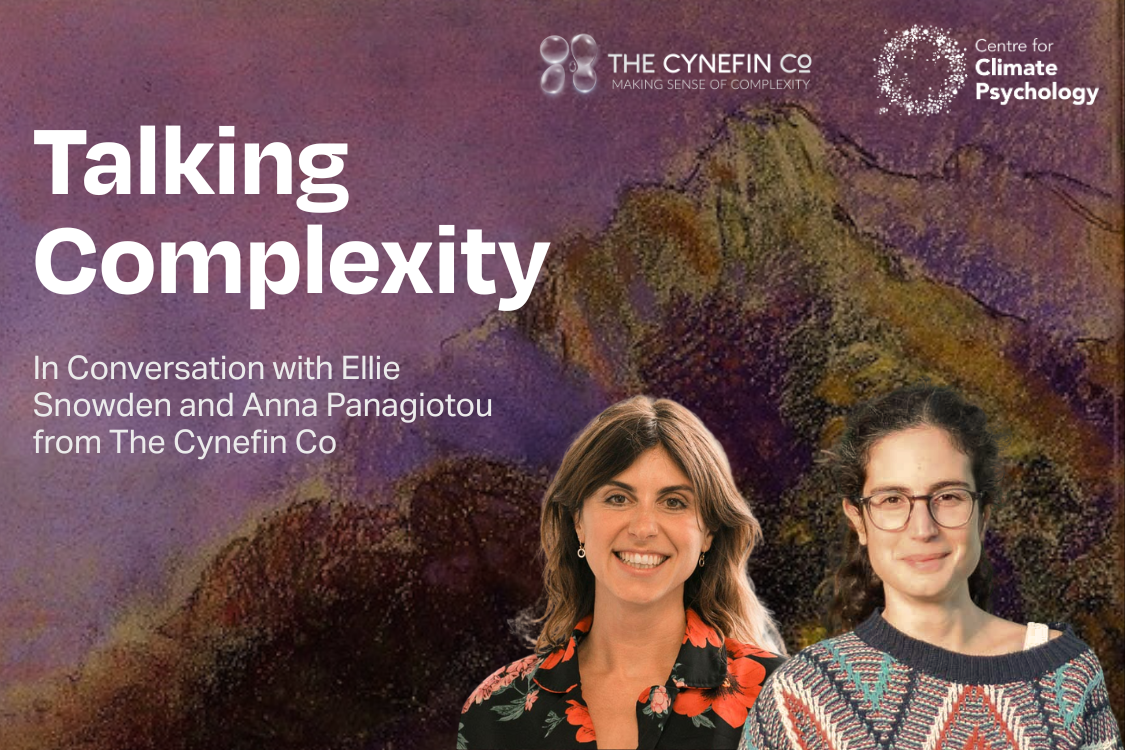
In this interview, Ellie Snowden and Anna Panagiotou from The Cynefin Co share how complexity science can help us better navigate the psychological and social dimensions of climate change. Rather than offering neat solutions, they invite us into a way of working that empowers people to take agency within their own context, helps them see the whole system, and opens new possibilities for systemic transformation.
On February 5, 2026, a new training offered by The Centre for Climate Psychology and The Cynefin Co begins. Keep reading to get to know our facilitators!
Ellie, you have been working in the field of complexity science for almost a decade. What does complexity mean to you, and how has the word and concept been adopted over time?
Ellie: “Indeed, I've been working in the wonderful and at times slightly odd world of complexity now for nine years! Despite growing up with the language of this field, I often find the word 'complexity' a little alienating. In my experience of supporting individuals and organisations to make sense of the world’s more intractable issues, I've noticed that naming something explicitly complex can create a freeze response or worries about not being smart enough or knowing enough about the theory to put it to good use.
To me, complexity is acknowledging the absolute messy reality of our personal and shared lived experience. Not in the ways we scaffold our workshops, systems, and structures with a false sense of security or linearity, an objective, or an end goal, but instead allowing the space for the mess to reside fully. And from this, to step into a place of curiosity and greater awareness of what is, rather than what we might like things to be.”
Anna and Ellie, how did you enter this field of work? What is your personal motivation to support people through this workshop you are hosting with the Centre for Climate Psychology?
Anna: “My background is in archaeology and anthropology. I entered the field of anthro-complexity, the intersection between complexity science and human beings and their particularities, in 2018, when I met Dave Snowden.
How do things change, and by whom? How do people in groups, large and small, make things work? What role do the material conditions of our lives play? These questions provided a bridge for me from the societies of the past to working with the present.
Among many other things, working with complexity resonated with me in one vital way: it allows us to explore creative tensions, the both-ands, rather than either-ors. We so often fall into the “stories vs data, individuals vs structures, this against that” framings that we trap ourselves and limit our range of response. So, navigating through multiplicity together is one of the journeys I am especially excited to take participants on!”
Ellie: “My personal motivation for supporting people through this workshop is not a desire to reduce the complexity of the complex. But rather to create a space for people to step into a process by which they feel, hear, see, and taste the realities of the present moment, in a way that can support movement in potentially new directions. I am keen to share some practical tools, methods, and heuristics to support people in their ongoing navigation, with the understanding that stepping into this world can become a lifelong endeavour!”
Many people in our community work at the crossover between psychology and climate change. Why might your complexity science perspective matter to them?
Ellie: “This area very much excites me and speaks to my background in social and medical anthropology as much as my work in complexity science. Psychology can tell us a great deal about the human experience. When combined with other disciplines, we can learn a great deal more about our interconnected realities and the webs of more-than-human worlds we belong with.
Complexity and anthropology offer a meta-analysis of the ways we see the world, and the ways we take for granted those ways we see the world (and their implications). Complexity situates the individual in a broader substrate or relational field, placing first-order sensation and environmental context at the forefront of our observation, which can provide freedom from labels or interpretations that are often inherited. This feels particularly vital when working with climate emotions and responses, where there's a risk of pathologising what might be rational, embodied responses to an ecological crisis.
Our approach to working with narrative and sense-making can illuminate a great deal about the cultural and attitudinal elements behind our interpretations of what is or isn’t possible. In the field of climate change, this means being in an intimate relationship between the granular — individual grief, eco-anxiety, the psychological weight of living through collapse — and the meta forces that shape our realities, which are in turn shaped by our interpretations and actions. It's about finding ways to open ourselves up, from what we expect to see to new imaginings of where we might head next — both as individuals and collectives navigating climate realities.
Anna: “I have a very close connection to this question! In the early days of my work with complexity science, I had just adopted our organisation’s climate change and sustainability programme, and had been grappling with the idea of action and inaction: what motivates us to take action, and why do we not take action even when we categorically know we should? I’ve drawn inspiration from psychology in those explorations, for example, to understand some of the individual forces between doubt and denial, but then integrate them with insights from complexity science. This is what I hope other people will end up doing in their own ways, for themselves, and in their work.
In our approach, complexity science helps us better understand the entangled web that we are all a part of – it is one of the tools that enables us to approach people as part of the world. It shows us how and why interactions are just as important as individual elements. From the point of view of complexity, we can approach the systems of climate change and its connections as an interconnected and irreducible whole, but also derive vital actions and principles for intervening in it.”
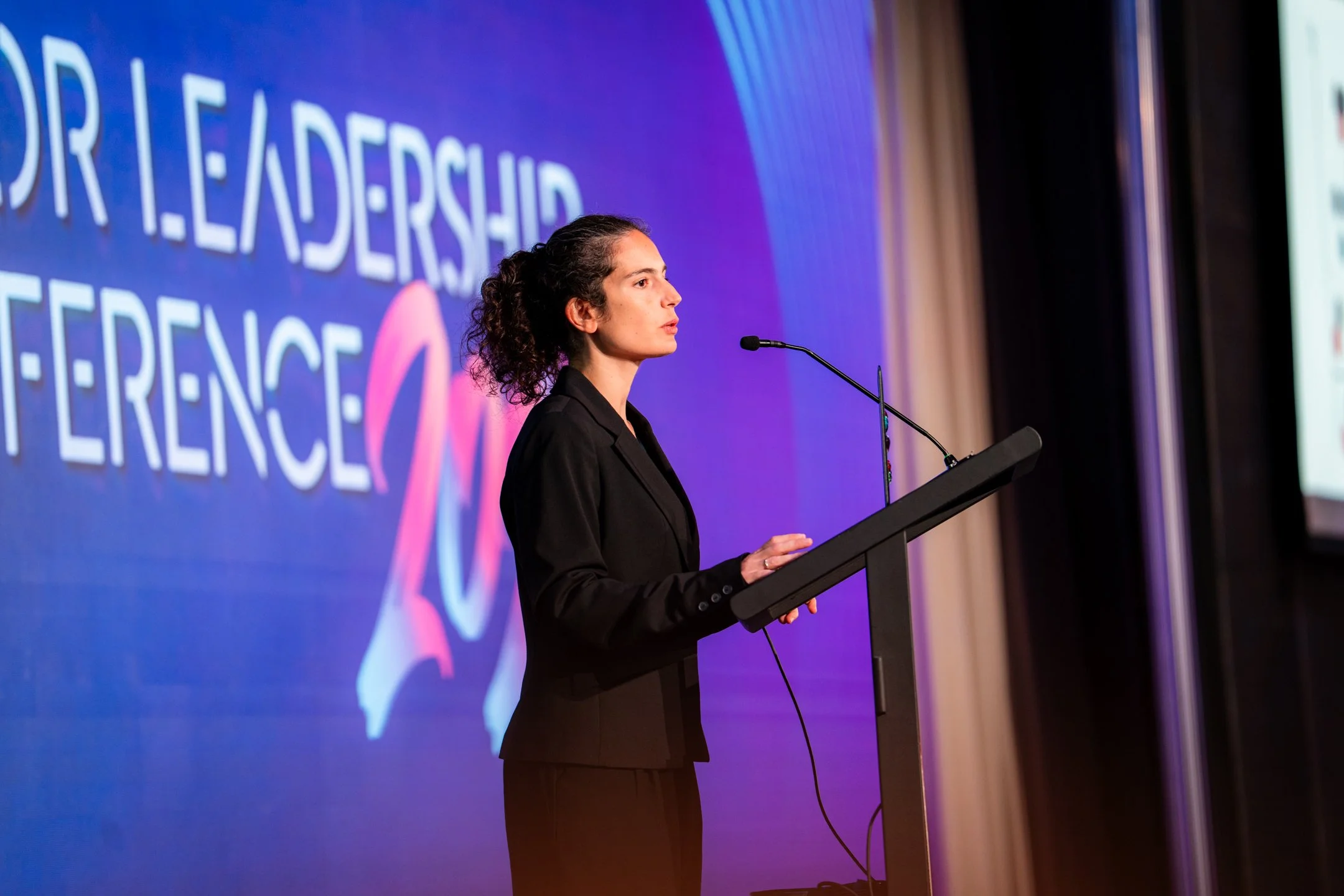
Anna Panagiotou speaking at the EFS’ Senior Leadership Conference 2025
Anna, could you expand on what you mean by “the systems of climate change and its connections?”
Anna: “The climate and everything it touches is a complex system, even before we bring people into the mix. The interaction between air currents, gas particles, ocean circulation, weather, vegetation, biodiversity, and agriculture — all of those things come together in incredibly dynamic ways, meaning that changes become non-linear and have many causes and consequences. Now, within those connections, we also need to consider people: what we think is right and wrong, what we think is worth doing, what is a good life, how we see our nations, the stories we tell about nature, participation in our political systems… and we are just scratching the surface. This is the system of climate change and its connections. The fact that it is so big and multifaceted doesn’t mean we have no hope of creating change. In fact, it means the opposite: that hope and the opportunity of change can often be found in unexpected, small places.”
Could you both share a story about how your work changed the operations of a client, and the transformations that followed from that?
Ellie: “Our work is not to lead transformation, but to create spaces where those living and breathing the realities of their context create their own transformations that are directly relevant to their needs in the moment. The most memorable work illustrating this was a project I was grateful to be part of, focused on the drivers of child and early forced marriage in contexts of displacement and food insecurity in two distinct settings: the Philippines and Rwanda. We partnered with the Women’s Refugee Commission, Plan International, and local research partners and NGOs to create a collaborative project in which young women, in particular, led the research design, analysis, and translation of insights into action.
Our Cynefin approaches to designing participative collaborations and using narrative sense-making to uncover and work with different cultural attitudes helped paint a rich picture of the affordance landscape for young women across these settings. It has paved the way for many small and large-scale action designs focused on areas such as food insecurity and family psychology. What strikes me about this work in relation to climate psychology is how it demonstrated the power of starting with lived experience rather than imposed frameworks, allowing people to name their own realities and design their own responses. This feels essential when working with the deeply personal and collective dimensions of the climate crisis.”
Anna: “For me, some of the most inspiring transformations that come to mind are in cases where people adopted the descriptive and participative nature of our narrative-based method to change a process that, before, only focused on rating and evaluation.
One non-profit organisation was very invested in making their local partners active participants in shaping an organisational strategy and in tailoring service delivery to their needs. This could never be done by asking them overly direct questions – that just put the local partner on the spot, and made them feel like they had to justify their presence and work, rather than participate in the process as equals. Direct questioning or rating was supplemented by the sharing of stories and making sense of those stories.
The impact emerged more vividly than ever before, and the weaker points were allowed to come to light because the context had changed.
Beyond changing attitudes towards evaluation, this ultimately transformed the way the organisation handled strategy and dealt with the complexity of its operations. The different picture of the value they bring to stakeholders helped them identify more avenues that enabled them to reach their goals.”
Starting February 5, Ellie Snowden and Anna Panagiotou from The Cynefin Co will host the training “Narrative, Hope, and Agency in Complexity: Acting in the World” in partnership with the Centre for Climate Psychology. If you are a practitioner, facilitator, educator, or change-maker who wants to work more effectively in complexity — whether your focus is climate, community, leadership, or organisational transformation — then this training is for you.