
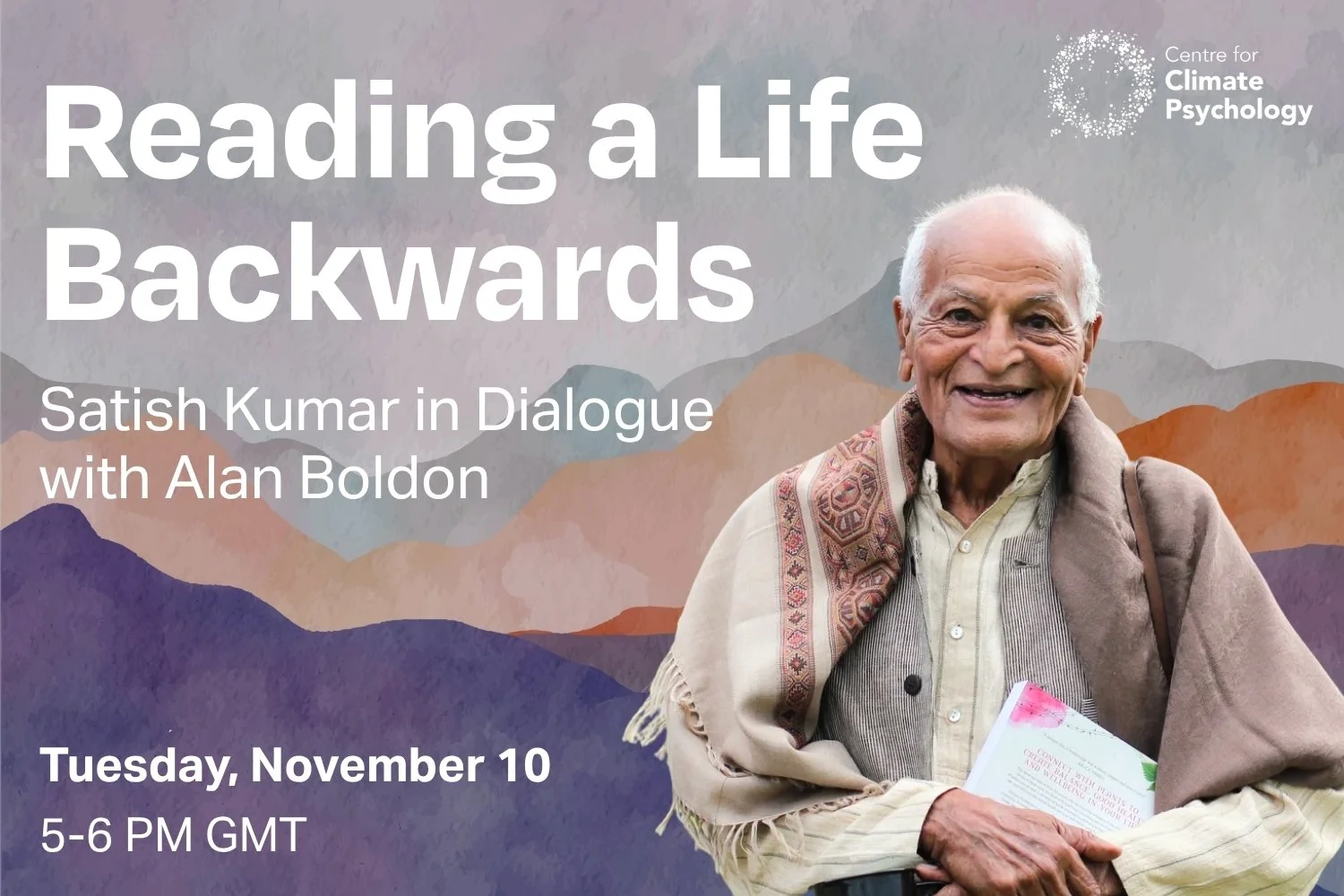
Join us for a special conversation to celebrate Satish Kumar’s 90th birthday.
What does a life devoted to peace, ecology and spiritual practice teach us about living through times of profound uncertainty and change?
At 90, Satish Kumar has spent more than seven decades exploring this question through the way he has lived. He has repeatedly stepped into the unknown without the resources, security, or certainty we often feel we need before taking the first step.
As a young man, he left his life as a Jain monk and walked eight thousand miles, without money, to the capitals of the world’s nuclear powers to advocate for peace. He campaigned alongside Bertrand Russell, edited Resurgence magazine for four decades, helped pioneer the small school movement, and co-founded Schumacher College, which became an internationally recognised centre for ecological thinking and transformative learning.
Satish has dedicated himself to weaving back together what has become separated, deepening our relationship with the Earth, with one another, and with our inner and spiritual lives. Underlying this is an understanding that our wellbeing, the wellbeing of our communities, and the wellbeing of the Earth belong together. In this conversation, we will explore what it means to build a life guided by these values, and what becomes possible when we begin to live them without waiting for all the conditions to feel right.
And at 90, Satish remains an active voice for peace, ecological responsibility and a radically different understanding of what it means to live well.
Come and celebrate Satish with us, hear some of the stories and wisdom gathered across his remarkable life, and find out what he believes these times are asking of us now. And don’t forget to bring the questions you would love to ask him
Practical Details
This is an online conversation that will last approximately 40 minutes, followed by 20 minutes of audience questions.
Date and Time:
Tuesday, November 10, 2026, 5-6 PM GMT (check your local time zone).
Tickets:
£5,- (All proceeds go to our scholarship fund, lowering entry barriers for people from the Global South to access our programmes.)